Bridging Tradition and Protection: Rethinking Justice and Security in Somalia’s Rural Communities
Justice, Security, and Survival in Rural Somalia

In early December 2024, I went to Adan Yabal district, a newly liberated area in the southeastern Middle Shabelle region of Somalia. The area had experienced long-standing insecurity, and as an IOM staff member, I was part of the team conducting a baseline assessment to help shape a pilot security and safety stabilization project.
It was my first field deployment, and I thought I was there to collect data. But in the middle of maps, questionnaires, and focus groups, a woman’s story found its way into our circle, and it shifted something in me. It made data feel alive, painful, and urgent.
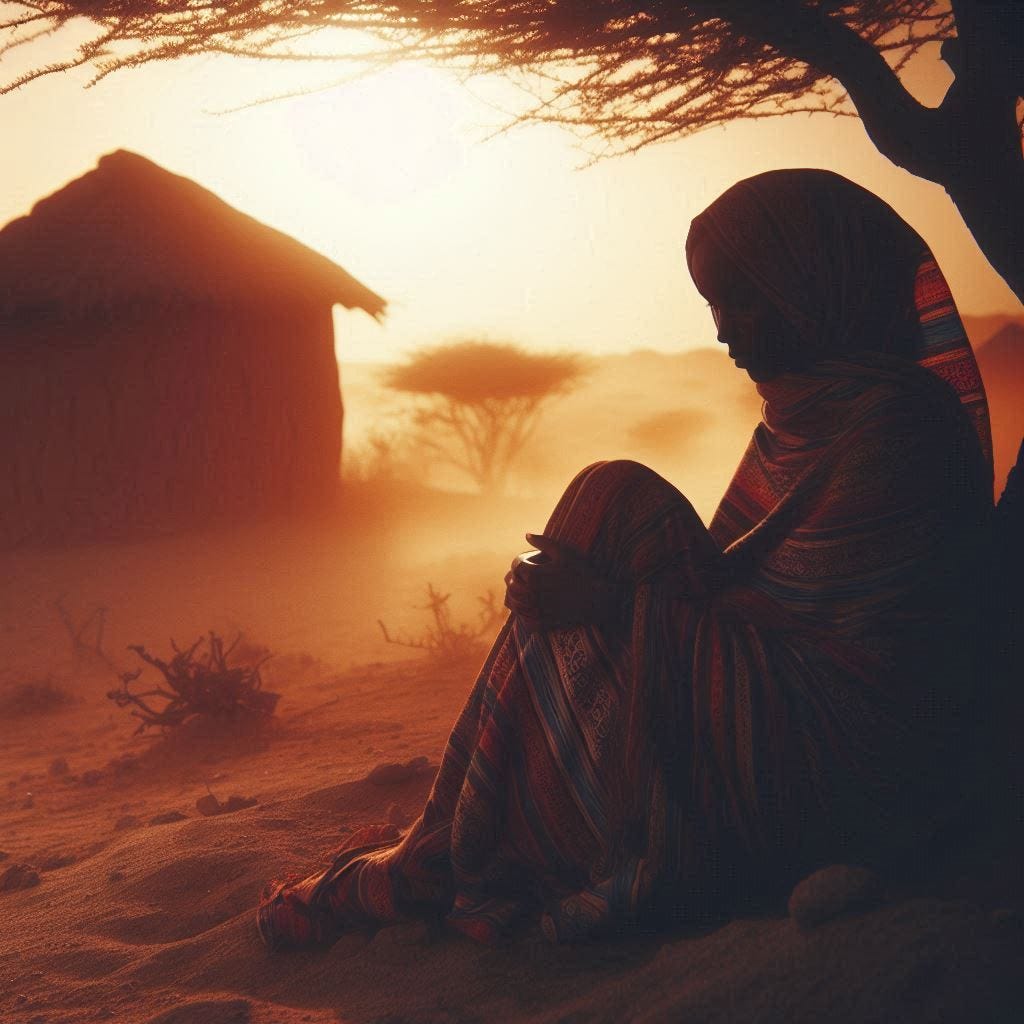
She was barely 18—perhaps younger—when her world changed forever. Tending her family’s livestock, she never imagined that silence would replace her voice, stolen by a man who took what was never his.
In her village, justice is measured not in truth, but in camels. Decisions are made by men, behind closed doors, while the survivor is left unheard. Her father accepted compensation, closing the case without apology, support, or even acknowledgment of her pain. Her fate was sealed. Married off to a man twice her age, she endured beatings, silence, and fear. When his drug-fueled rage turned violent, the police intervened briefly—only to send the families back to “solve it among themselves.” A divorce was arranged on paper, but the scars remained.
Then, a glimmer of hope. She met someone new—a man she chose. They moved to Mogadishu, where her past felt distant, almost forgotten. Love bloomed, and with it, a child. A second chance. A future of her own making.
But whispers travel far. Her former husband resurfaced, poisoning her happiness with a lie: “That child is mine.” Doubt crept into her new marriage, eroding trust until it collapsed. Heartbroken and pregnant, she returned to Adan Yabal—the very place where silence first stole her voice.
Labor came violently. Weak and exhausted, she slipped into darkness. When she woke, her aunt wept beside her. The baby was gone.
Now, she lives in quiet solitude, her dreams buried beneath grief. Some days she speaks; most days she does not. But sometimes, just for a moment, she smiles. A distant, knowing smile, as if remembering the girl she once dreamed of becoming. As if, even in silence, her story still speaks.
Layers of Justice: Custom, Security, and the Push for Reform
A. The Role of Elders in Rural GBV Dispute Resolution
In many rural areas like Adan Yabal, traditional elders play a central role in resolving disputes, including cases of gender-based violence (GBV). Their system, often referred to as xeer (customary law), has governed community affairs for decades—particularly in the absence of a functioning state.
When we spoke with elders during our visit, they emphasized the necessity and reliability of this system:
“Since the collapse of the central government more than 30 years ago, there has been no formal administration or governance in our area. To maintain order, the community came together and established a customary system where traditional elders resolved disputes and delivered justice. People accepted their rulings, and the system functioned like a government.”
For them, customary law is familiar and deeply rooted in tradition. “This is how our ancestors solved such issues,” many explained. It is a system built around communal harmony and collective resolution, often prioritizing the interests of the families involved over the individual rights of survivors.
However, while this approach may be functional in maintaining community cohesion, it is not always fair, especially for survivors of GBV. The customary system is not survivor-centred; it often excludes the voices of women and girls, overlooks their trauma, and lacks mechanisms for protection, redress, or accountability for perpetrators.
Elders openly acknowledged this gap. While they defend the system as the only one available to them, many admitted that it falls short in delivering just outcomes for survivors:
With no functioning courts or legal infrastructure in place, community members—especially survivors—are left with little choice but to accept resolutions through customary law, even when those resolutions do not reflect justice.
In rural areas like Adan Yabal, the role of the police in addressing disputes, including gender-based violence, is significantly limited. While police officers are present and expected to uphold law and order, their involvement in resolving community-level disputes is often minimal. Instead, most cases are redirected to traditional elders and family-based mechanisms.
This practice stems from longstanding community norms. Even when the police attempt to intervene, families frequently request that matters be resolved through customary law. In many cases, the police step back and allow the elders to mediate. Once an agreement is reached between families, usually based on compensation or verbal settlements, they return to the police simply to report the outcome. The case is then considered closed.
Only in rare instances, where further legal action is sought (such as imprisonment or formal prosecution), are cases formally handed over to the police. However, such transitions are uncommon due to several barriers:
Lack of familiarity with the formal legal system among both community members and local officers.
Weak integration between police forces and the communities they serve—many officers are newly deployed and unfamiliar with the local context or social dynamics.
Historical disconnection from formal governance—many rural communities have not experienced consistent state presence or legal services since the collapse of Somalia’s central government over three decades ago.
This disconnect not only reduces the authority of the police in local dispute resolution but also perpetuates a cycle where survivors of GBV are left without legal protection or justice. Survivors are often isolated, their cases managed through informal systems that prioritize reconciliation over accountability.
The result is a deepening mistrust in formal institutions—and for survivors, a feeling that justice is neither accessible nor designed for them.
C. What Needs to Change: Building a Just and Survivor-Centered System
The current justice landscape in rural Somalia, particularly in newly stabilized areas like Adan Yabal, relies heavily on customary dispute resolution. While traditional systems offer community familiarity, they are not designed to protect survivors or uphold their rights. A transformative shift is needed, centered on four critical pillars:
1. System Reform: Gradual Shift Toward Statutory Justice
There needs to be a progressive transition from customary to statutory justice, starting with building public understanding and belief in formal systems. This means:
Introducing legal education in schools, so the younger generation grows up understanding their rights under statutory law.
Encouraging joint dispute resolution, where security actors are present alongside elders when handling cases, particularly GBV or serious disputes.
Training and deploying local security forces familiar with the communities they serve, to ensure trust and relevance.
Celebrating successful resolutions by security forces to build public trust and show the community that fair justice is possible through formal means.
This transition requires time, visibility, and active community engagement to replace outdated systems with ones that uphold human rights.
2. Public Awareness and Legal Literacy
For the shift to take root, communities must understand the value of statutory law and how to access it:
Launch community-wide awareness campaigns using storytelling, drama, and law plays to explain step-by-step how justice can be sought through legal systems.
Facilitate open community dialogues with elders, youth, women, and religious leaders on the limitations of customary law and the benefits of survivor-centred justice.
Use local radio and peer educators to spread accurate information in accessible formats.
3. Institutional Infrastructure and Capacity Building
For people to rely on formal justice, it must exist and function reliably:
Build and equip courts and police stations in rural and liberated districts.
Train police officers and judiciary staff on community-sensitive approaches, especially for GBV cases.
Develop clear case referral systems from elders topolice and from police to courts, ensuring cases don’t fall through the cracks.
4. Learn from Regional Success Stories: Kenya and South Sudan
Somalia doesn’t need to start from scratch. There are important regional lessons we can adapt from South Sudan and Kenya, where communities successfully integrated statutory systems into traditional settings.
South Sudan:
Used mobile courts to bring formal justice closer to rural communities.
Trained traditional chiefs on national law and human rights, encouraging them to refer GBV cases to police and courts.
Facilitated dialogues between chiefs, police, and judicial officers to clarify roles and promote cooperation.
Kenya:
Trained community paralegals—especially women and youth—to act as legal educators and support survivors.
Linked alternative dispute resolution (ADR) :led by elders with oversight from formal courts.
Introduced school-based civic education to build legal literacy from a young age.
Mapped GBV response pathways to clarify each actor’s role and train them accordingly.
Somalia can adopt similar steps, using community-led approaches to connect traditional systems with statutory law, ensuring access to fair, transparent, and survivor-centred justice.
Final Thought
True justice cannot exist without listening to survivors and honoring their voices. By bridging tradition with statutory law—and ensuring police and security actors are trained, trusted, and integrated into community justice—Somalia can build a system that protects, restores, and empowers survivors
This piece of paper touched me deeply,I felt every word. Thank you, Fatima, for such a beautiful article.